|

|
Edmond Halley (1656-1743), in 1694, produced a general method for finding approximations to solutions of functional equations g(x) = 0. The method is similar to the Newton's method but more rapidly convergent. Halley's method yields two different fomulas for finding the nth iteration: the rational and irrational formulas, the latter getting the name from having a square-root in the formula.
To apply this method to find the cube root of a number Q, the function g = x3-Q.
Halley's rational formula yields the following for cube-roots:
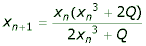
The convergence is cubical. That is, after a few iterations, the number of correct digits of √Q increases by 3 at each iteration.
REFERENCES
G. Alefeld, "On the convergence of Halley's method", Amer. Math. Monthly, 88 (1981) 530--536.
Ü BACK
MathPath - "BRIGHT AND EARLY"
Send suggestions to webmaster@mathpath.org
© 2001- MathPath
Last updated - March 3, 2006
|